
Precast concrete vs. cast-in-place: schedule, cost drivers and tolerances
Compare factory precast and site-cast concrete through procurement, curing, crane access, interfaces and tolerance coordination.
Precast concrete moves component casting into a production facility; cast-in-place concrete forms the element at its final location. The decision turns on repetition, design readiness, transport and lifting access, site geometry and connection requirements. Compare the completed structural system, including temporary works and interfaces, rather than a concrete unit price.
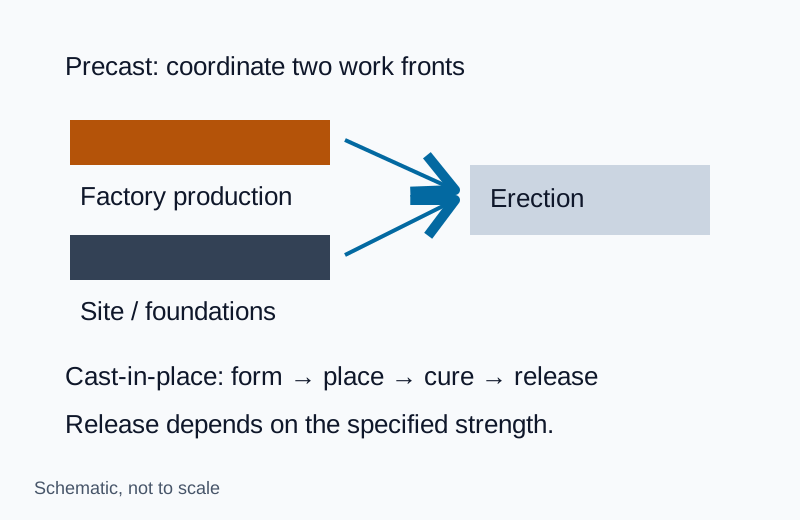
Factory production can overlap with foundation work when design and procurement are ready. Cast-in-place can accommodate continuous or irregular geometry while bringing formwork, placing, curing and strength-release activities onto the site. Both require planned curing and verified strength at the relevant stages.
Compare the work packages
| Decision | Plant precast | Cast-in-place |
|---|---|---|
| Design release | Component geometry, embeds and connections fixed before production | Forms, reinforcement, joints and embeds coordinated before placement |
| Site sequence | Delivery, lifting, temporary support, connections and closure work | Formwork, reinforcement, placement, curing and approved stripping / reshoring |
| Access | Haul route, delivery staging and crane working area | Concrete delivery or pumping, placing access and formwork storage |
| Change impact | Late changes can affect fabricated components and delivery slots | Changes can affect installed forms, reinforcement and planned pours |
| Finish and interfaces | Panel joints, bearing, connection and sealant details | Pour joints, surface finish and dimensional control |
Tilt-up is cast on site before panels are lifted into position; it has different casting-space and logistics requirements from plant-produced precast. Prestressing is a design and manufacturing choice, not a property of every precast product.
Schedule the release conditions, not just the pour
Include shop-drawing approval, production allocation, component manufacture, transport permits, crane availability and connection completion in the precast programme. Confirm that foundations and embeds are surveyed before the delivery sequence is committed.
For cast-in-place work, include formwork and shoring inspection, concrete placement, curing, strength verification, stripping and reshoring where required. Winter conditions can change protection and temperature-control needs. Factory production changes where curing occurs; it does not eliminate curing or make site connections immune to weather.
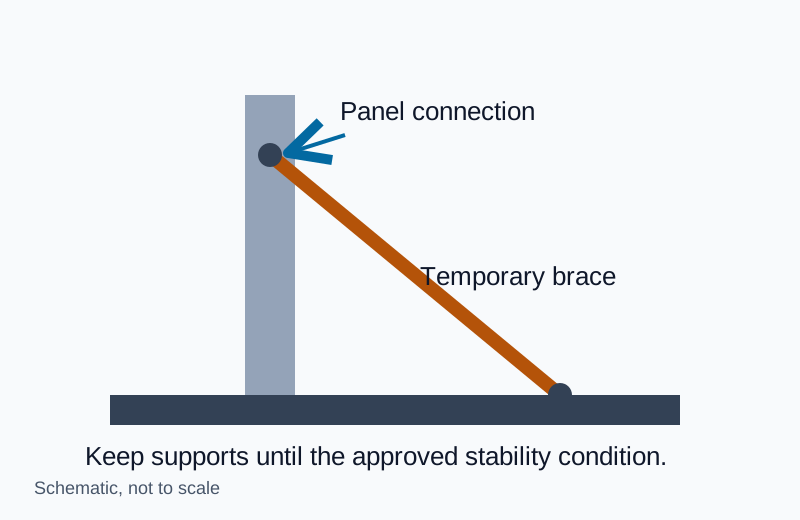
U.S. OSHA 1926.703 addresses cast-in-place formwork, shoring and removal conditions. 1926.704 addresses precast support, lifting inserts and hardware, and employee exposure during lifting. The erection and temporary-works plans must match the actual member and operation.
Tolerances accumulate at the interface
The Precast/Prestressed Concrete Institute tolerance overview separates component, erection and interfacing tolerances. PCI states that PCI 135, issued in 2025, supersedes the tolerances in MNL 135. Establish the contract’s applicable edition and transition requirements; do not substitute a generic tolerance range for the relevant component and interface.
The NPCA explanation of typical tolerances likewise distinguishes product, erection and interfacing tolerances. A component within its manufacturing tolerance can still fail to fit if adjacent work and erection position consume the available connection allowance.
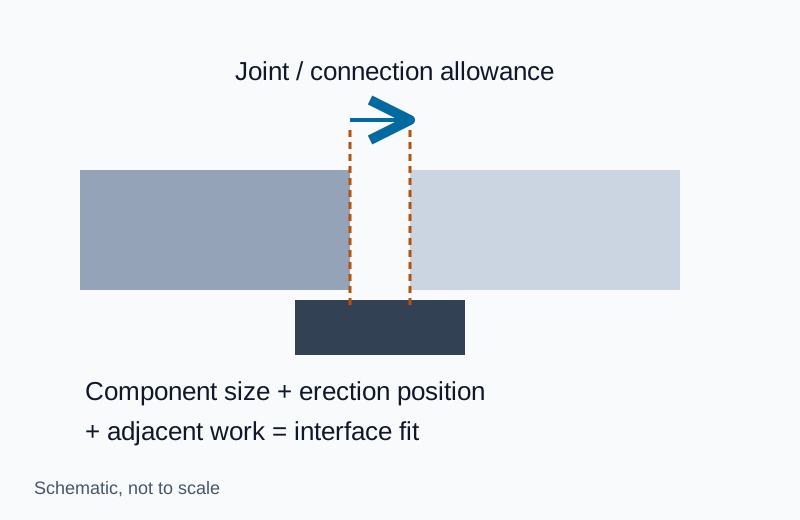
Prepare a tolerance matrix for foundations, bearing surfaces, embeds, sleeves, panel joints and adjoining façade or MEP work. For cast-in-place elements, identify the specified ACI 117 provisions and any project-specific requirements. Record who surveys each interface, when the survey occurs and who approves an out-of-tolerance condition.
Grouted sleeves, pockets and bearing details require their own manufacturer and designer requirements. Verify access for inspection and grouting, approved grout, installation conditions and strength-release criteria. Enlarging a pocket or modifying reinforcement in the field requires an approved disposition.
Cost drivers to put on the same bid sheet
Compare engineering and shop drawings, mould or formwork reuse, concrete and reinforcement, transport, permits, lifting, temporary works, site labour, connections, grout, finishes, inspection and risk allowances. Repetition can spread setup effort across more units; transport dimensions, load mass and route restrictions can change logistics sharply.
For commercial buildings, test delivery and crane sequencing against the available working area. For utility corridors or below-grade structures, include excavation support, water control, joint sealing and backfill release. A low component price can be offset by expensive access or unplanned connection work.
Questions before selecting a system
Confirm the geometry and loads with the structural designer, then ask suppliers and contractors for an integrated sequence. Identify the design freeze, verified interface dimensions, delivery constraints, lifting responsibilities and inspection hold points. Tie each proposed schedule saving to a specific activity that can actually overlap or be removed.
Obtain project-specific erection and rigging engineering. Published lifting factors are legal minimums for particular hardware categories and conditions, not a crane selection or lifting plan. Workers must be protected from instability and suspended-load hazards throughout erection.
Explore modular and prefab building systems for SIPs and light-steel interfaces, or BIM coordination to resolve connections and service routes before fabrication.
Explore the related topic and technical references.