Smart Construction
Independent guides to construction technology, connected workflows, and the decisions that make jobsite tools useful.
Smart construction connects field information with a decision someone is responsible for making. A sensor, model or dashboard is useful only when the team can explain what it changes: a work release, an inspection request, a coordination decision or an owner handover record.
This section helps project teams define that connection before buying technology. Use the workflow and evaluation questions to select a bounded pilot with clear supervision and decision responsibilities.
Start with the problem, not the platform
Write down one decision that currently arrives late or without enough evidence. Identify who makes it, what information they need and what happens if the information is wrong. “Improve visibility” is too broad to test. “Give the supervisor a location-linked record of unresolved inspections before tomorrow’s work is released” is a more useful brief.
Our smart construction site guide develops this approach into a bounded pilot. If the underlying problem is unclear trade responsibility or unreliable daily commitments, begin with site management first. Digitizing an unresolved process can preserve the same ambiguity in a more expensive form.
Match the use case to the evidence
| Your question | Information to request | A limitation to examine |
|---|---|---|
| Is work progressing as planned? | Location, capture date and definition of completion | A photograph may show installation, not acceptance |
| Has an issue been resolved? | Assigned owner, revision history and closure evidence | Changing a status label does not verify the fix |
| Is a monitored condition unusual? | Device location, measurement context and response owner | Missing or stale readings can resemble normal operation |
| Can the owner use the records later? | Export sample, identifiers and linked documents | Access may depend on an ongoing subscription |
Set the evaluation criteria using the project’s design, contract and information requirements. A tool that is useful for progress communication may be unsuitable for a safety-critical decision.
Define the minimum workable record
A simple record should let a different team member understand where an observation belongs, when it was made and what follow-up is expected. Include a location reference, an accountable role and the relevant drawing or document revision. Distinguish observed facts from interpretation.
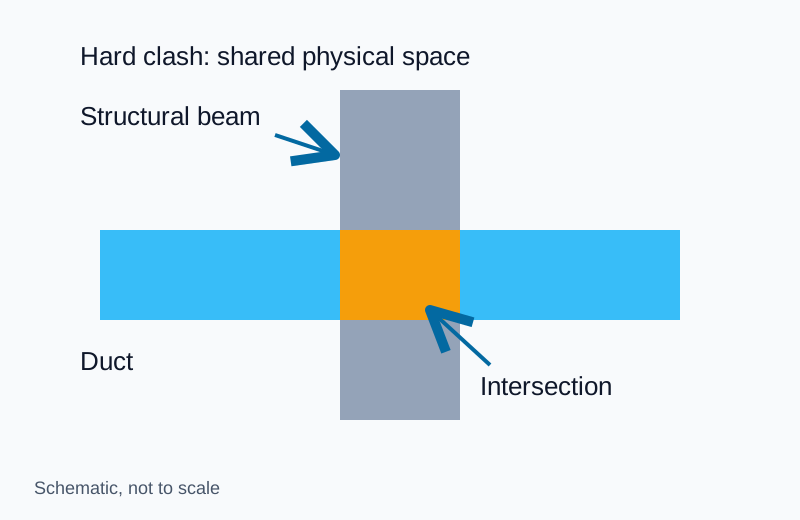
Consider an illustrative ceiling-coordination issue. A photograph without a room reference may be difficult to find later. A room reference without the current drawing may point to obsolete work. A complete record still needs an authorized person to decide whether installation can proceed. Keep the location, drawing revision and decision together in the issue record.
Agree how corrections work. If someone uploads an image against the wrong room, the system should preserve a clear correction trail rather than silently leaving two conflicting records.
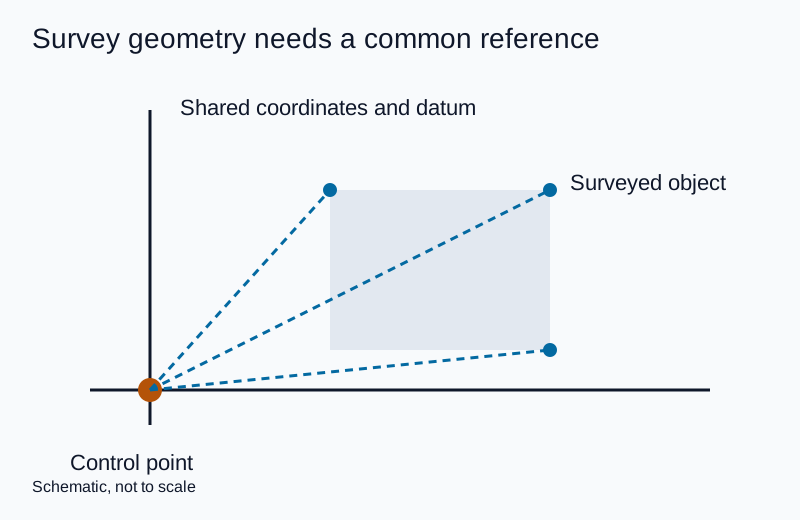
For survey and model coordination, keep the units, origin and coordinate reference with the spatial data. Check exchanged geometry against site control before dimensional use. The smart jobsite technology guide explains the survey checks.
Examine security and data ownership early
For connected devices, the NIST IoT device cybersecurity capability baseline is a starting reference for evaluating capabilities such as identification, configuration and software updates. It is not a certification that a particular construction product is secure.
Ask the supplier who administers accounts, how access is removed when a subcontractor leaves, how updates are supported and which records can be exported. Get a sample export before relying on a sales statement about “open data.” Check that attachments and location relationships survive the export.
Images and monitoring records may include workers or sensitive project details. Define an appropriate collection purpose and obtain jurisdiction-specific privacy advice where needed. Collecting more data is not automatically a better project outcome.
Run a pilot with a stop decision
Choose a limited work area and a single operational use case. Record the existing process, the expected improvement and the extra effort required from field users. Include ordinary conditions such as weak connectivity, a changed crew or a corrected drawing.
At the end, ask whether the information actually changed a decision, whether the responsible people trusted it and whether the support burden was manageable. Keep a record of unsuccessful uses as well as successful ones. Decide whether to expand, revise or stop; a pilot should not become a rollout simply because equipment has arrived.
Connect digital records to physical work
Technology choices intersect with other parts of the library. Construction site management explains readiness and handoffs. Building material systems covers product and assembly information that may need to remain usable at closeout. Building restoration explains why condition records must distinguish observations from conclusions.
Does every project need a digital twin?
No particular label establishes a project need. Define the decisions and records first, then evaluate the simplest process that meets them. A maintained issue register can be more useful than a sophisticated model nobody is accountable for updating.
Can an automated status authorize work?
A system status should not be assumed to grant contractual, inspection or safety authority. Identify the person or role empowered to release the relevant work and make the approval boundary explicit.