Site Management
Practical site-management guidance covering daily coordination, production controls, safety, quality, and handoffs.
Site management is the coordination of people, information, access and verification needed to turn a plan into completed work. Its practical test is whether a crew can begin a defined task with the right prerequisites and leave a usable handoff for the next trade.
This section focuses on planning conversations and records that support those decisions. Use it alongside the project safety plan, assigned contractual responsibilities and competent supervision.
Choose the planning problem you need to solve
Start with our construction site management guide for a complete readiness-to-handover framework. Use the questions below to locate the weak point in your current process.
| What you see | What to examine | Useful next record |
|---|---|---|
| Crews arrive but cannot start | Access, design answers, materials and preceding work | Constraint register with owners and dates |
| Work is installed but cannot be closed | Inspection requirements and acceptance evidence | Location-based quality record |
| Several trades claim the same space | Shared access and sequencing assumptions | Coordinated short-term area plan |
| The same issue returns each week | Whether closure was verified | Decision log with supporting evidence |
| Reports are lengthy but decisions are late | Audience, timing and escalation responsibility | Short exception list for the next decision |
Do not assume every delay has the same cause. An unavailable crane slot, an unresolved design detail and missing inspection evidence need different owners and different responses.
Separate the schedule from work readiness
A scheduled date expresses an intention. Readiness requires checking whether the conditions for that work are actually in place. A useful look-ahead discussion asks what can prevent the task, who can remove the constraint and when a decision is needed.
The Lean Construction Institute’s Last Planner System overview explains a collaborative planning approach that connects planning, commitments and learning. Use its planning stages to connect commitments with readiness checks and review of completed work.
For an illustrative room-fit-out package, readiness could depend on released drawings, suitable access, delivered components and completion of preceding inspections. Listing the room as “ready” without explaining these conditions can hide disagreements between trades. Record the specific limitation when a task is only partly ready.
Give the daily meeting a decision output
A daily coordination meeting should produce more than a record that people attended. Identify today’s work areas, important changes, conflicts and decisions that cannot wait until the next meeting. Confirm which person owns each unresolved item.
Keep detailed supporting documents available, but make the immediate action list short enough to use. Record the location, constraint, owner and next review point. If the responsible role is absent, identify an escalation route rather than assigning a deadline to someone who has not accepted it.
Close the loop at the next review. An item can be completed, superseded or still blocked; these are different outcomes. Do not delete an unresolved constraint merely to make the report look cleaner.
Make handoffs understandable to the next trade
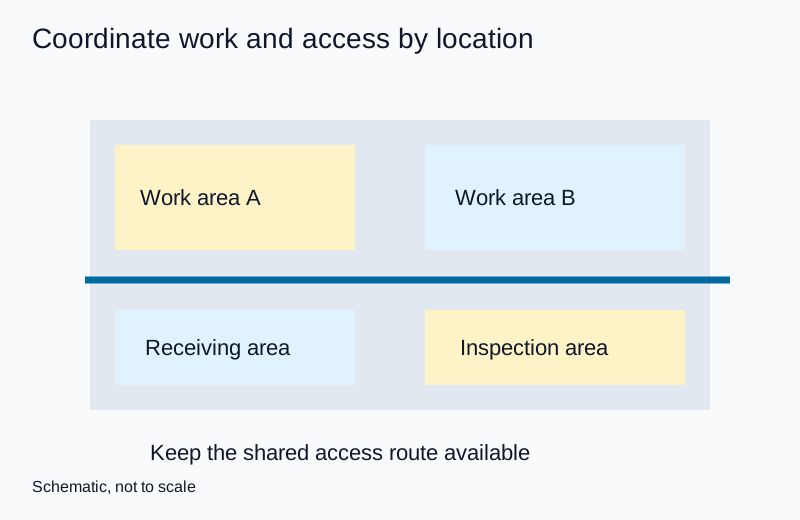
A handoff needs a defined boundary. State which room, zone, component or work package is being transferred and what remains excluded. Attach the applicable inspection or acceptance record where required.
The receiving trade needs to know whether the area is available, what must be protected and whether any restrictions remain. A photograph can help establish location and visible condition, but it does not replace every required test or approval.
Material interfaces deserve particular attention. The building materials and systems hub explains why a substitution or missing transition detail can affect more than one trade. For repair work, the building restoration hub helps frame uncertainty in existing conditions before commitments are made.
Use measures that answer a question
A measure is useful when the team knows what it includes and how it informs a decision. Completed commitments, open constraints and unresolved inspections describe different aspects of work. They should not be combined into an unexplained “project health” score.
Record the basis of each measure. If a task is split or removed after a commitment is made, explain how the record changes. Otherwise the apparent improvement may come from changing definitions rather than better coordination.
Ask what action follows an unfavorable result. If the team cannot name one, simplify the report or reconsider the measure. Our smart construction hub addresses tools that can support this information flow without allowing a dashboard to become the only source of context.
Questions to settle before the next work package
Who can release the work? Which prerequisites are confirmed, and which remain assumptions? What evidence will demonstrate completion? Who receives the handoff? How will a changed condition be reported before it affects another crew?
Use these questions to prepare the work-planning brief. Project documents and responsible professionals establish the applicable requirements.
Is a daily report the same as a coordination plan?
No. A report records what happened; a plan establishes intended work and prerequisites. They can inform each other, but a detailed retrospective report does not by itself resolve tomorrow’s constraints.
Should every issue go into the same system?
A common reference can help retrieval, but emergency response, formal approvals and routine coordination may need different channels. Clarify those boundaries and avoid treating an ordinary issue queue as an emergency service.