
Construction Site Management: Daily Planning, Coordination and Control
Build a practical construction site management routine covering work readiness, trade coordination, deliveries, inspections, changes and daily records.

Construction site management turns a project schedule into work that crews can actually perform. It connects people, information, materials, access, safety arrangements and inspection requirements at a particular place and time. A task appearing on today’s schedule does not mean those conditions are ready.
The practical aim is a reliable operating picture: what can start, what is blocked, what changed and who must act next. This guide presents an owner- and supervisor-facing system for daily control. Apply the routine alongside site-specific safety planning, qualified supervision and the agreed contractual procedures.
Quick answer: what does a site manager control each day?
Confirm the work areas and planned outcomes, verify the conditions required to start, coordinate overlapping activities, and record actual progress and exceptions. At the end of the shift, use the findings to revise the near-term plan.
A useful record links every significant issue to a location, responsible person, decision date and current status. The system can use paper or software. Its value comes from making decisions visible and keeping them current, not from the number of forms completed.
Define responsibilities before assigning tasks
A project may have a site manager, superintendent, trade supervisors, safety professionals, inspectors and a separate project manager. Titles vary. Write down who coordinates the work, who directs each crew and who can approve technical or commercial changes.
For projects within Great Britain’s relevant framework, HSE’s principal-contractor guidance describes duties to plan, manage, monitor and coordinate the construction phase. That is a jurisdiction-specific role, not a universal definition of every site manager worldwide.
Use the project’s actual appointments and requirements to establish responsibility. A coordination meeting does not transfer an engineer’s design responsibility to a foreman, and a delivery signature should not be treated as technical approval of a substituted product.
| Decision | Responsibility to identify | Evidence to retain |
|---|---|---|
| Daily work allocation | Site lead and relevant trade supervisor | Agreed location, outcome and restrictions |
| Technical clarification | Authorized designer or technical reviewer | Referenced response and affected document |
| Inspection release | Designated inspector or approval authority | Result, area and permitted next activity |
| Material substitution | Required technical and commercial approvers | Approved product and change reference |
| Access conflict | Site coordination lead | Revised sequence or area arrangement |
| Additional scope | Authorized contract representative | Instruction and agreed change process |
Confirm the responsibility map against the project appointments and applicable legal duties.
Convert the schedule into a readiness check
A milestone tells the team what is needed by a date. A readiness check asks whether the next task can be performed as planned. Keep those two conversations connected.
Before a supervisor commits to a work package, check its prerequisites:
- Current approved information is available at the point of use.
- Preceding work and required inspections are complete.
- Materials are present, identifiable and accepted for the intended use.
- The crew, equipment and authorized supervision are available.
- Access and work areas are coordinated with other activities.
- Required safety arrangements and permits are in place.
- The completion condition and receiving trade are understood.
This list does not replace a task-specific risk assessment or permit. It helps prevent a production commitment from being made while essential conditions remain unresolved.
Keep a constraint register with real owners
A constraint is something preventing planned work from becoming ready. “Awaiting information” is too broad to manage. State which detail is missing, who can resolve it and when the answer is needed to avoid affecting the plan.
| Field | Illustrative entry |
|---|---|
| Work package | Corridor ceiling closure, Level 2 |
| Constraint | Required above-ceiling inspection not released |
| Action owner | Assigned inspection coordinator |
| Needed by | Before the scheduled closure shift |
| Evidence of resolution | Recorded acceptance for the stated area |
| Current status | Blocked; other approved work may proceed |
Keep “inspection requested” and “inspection accepted” as separate states.
Review constraints before they become same-day emergencies. Keep unresolved items visible when dates move, rather than deleting them to make the plan look achievable.
Run a short coordination meeting that ends in decisions
Start with changes that affect today’s work: unavailable areas, revised information, late deliveries, inspection outcomes and interfaces between trades. Confirm who needs to change their plan and how the change will reach the crew.
Avoid reading every line of a report aloud. Routine updates can remain in the shared record; meeting time should resolve dependencies, assign actions and clarify uncertainty.
OSHA’s communication and coordination guidance emphasizes exchanging hazard and control information among employers on multiemployer worksites. This supports coordinating interactions before work begins. It does not mean a generic daily meeting covers every required safety process.
Workers also need a usable route for reporting changed conditions. A plan that cannot be questioned when the field differs from the drawing is not a reliable control system.
Coordinate by location as well as trade
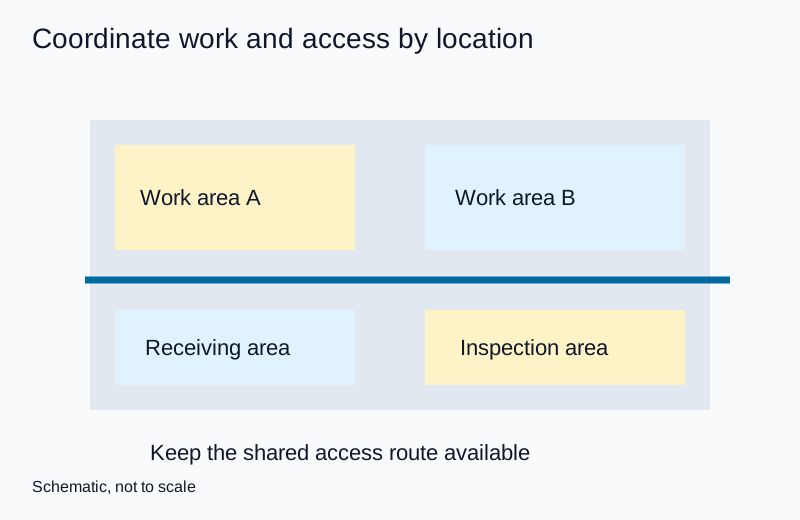
Two crews may each have a valid task but still need the same access route, lifting area or room. A trade-by-trade schedule can hide that conflict.
Use a simple area view: location, activity, time window, restrictions and receiving trade. Include temporary storage and waste movement when they affect access. Recheck the arrangement when one activity finishes late or expands beyond its expected boundary.
For restoration projects, work zones may also depend on assessment and release decisions. The fire restoration guide illustrates why limited access, cleaning completion and return to normal use can be separate milestones.
Make deliveries part of the production plan
A material is not ready for installation merely because a truck has arrived. The team needs to know what was delivered, where it is stored, whether it matches the approved item and whether the required receiving checks are complete.
Keep the delivery reference attached to relevant product and batch information where traceability is required. Record damage, shortages or substitutions before they disappear into general stock.
Plan unloading and movement through the site’s approved logistics arrangements. Do not direct vehicles or lifting activities using an informal diagram from an article. Those operations require competent planning and appropriate controls for the actual site.
Storage is also a coordination issue. Materials awaiting use should not occupy a workfront needed by another trade or lose the protection required by the product instructions. Assign responsibility for accepted, rejected and quarantined items so they are not confused.
Control information at the point of work
Maintain one defined route for issuing current drawings, specifications and approved changes. The crew should be able to identify the applicable revision without comparing screenshots from several conversations.
When a revision arrives, record which activities and areas it affects. Confirm whether existing work, procured material or a planned inspection needs review. Distributing a new file is not the same as confirming that the affected team has understood the change.
Keep requests for clarification distinct from instructions. A question sent to a designer is not approval to proceed with the proposed answer. Establish what the team may safely and legitimately do while awaiting the response.
Our building material systems guide provides related questions about substitutions and interfaces. Site control should keep those decisions traceable to the actual installed work.
Inspect before the next trade covers the evidence
A completion claim needs a defined endpoint. “Installed” might mean the crew has finished placing material, while testing, inspection or defect correction remains open.
Identify inspection hold points in advance. Name the person who requests the inspection, the reviewer, the evidence needed and the area that may proceed after acceptance. Do not wait until the next trade is standing at the workfront to discover the requirement.
For example, concrete restoration may need checks before placement and separate conditions for later loading or coating. The site plan should reflect those releases rather than use one generic finish date.
Track defects by location and required action. Closure should include verification, not simply a contractor’s message that the item has been addressed.
Keep daily reports factual and useful
A daily report should preserve what happened, especially where it differs from the plan. Distinguish direct observation from information reported by another person.
Useful fields include the date, work areas, crews and activities, measurable progress where appropriate, deliveries, inspections, changed conditions, instructions and unresolved issues. Link photographs to locations and descriptions rather than uploading an unlabelled gallery.
Write “crew reported missing fixings; delivery reference pending” when that is what is known. Do not write “supplier caused delay” unless the record supports that conclusion. The same discipline makes reports more useful for coordination and later review.
Record the decision as well as the problem. An issue that was resolved by resequencing should show the new arrangement and any consequences for downstream work.
Use metrics to improve planning, not to reward appearances
The Lean Construction Institute’s Last Planner System overview describes collaborative planning and learning from commitments. LCI defines Percent Plan Complete (PPC) as commitments completed on the promised day divided by all commitments in the weekly plan, expressed as a percentage. Count an assignment only when it is fully complete as planned.
PPC = commitments fully completed as planned ÷ total weekly commitments × 100. Track overall project progress separately using the agreed quantities or milestones. Keep task definitions stable and investigate the reasons for noncompletion.
Combine a small number of measures rather than relying on one headline:
| Measure | Management question |
|---|---|
| Overdue constraints | Which unresolved decisions threaten upcoming work? |
| Planned commitments completed | How reliable was the short-term plan? |
| Inspection first-pass outcomes | Where does execution or preparation need attention? |
| Defects awaiting verification | What is preventing actual handover? |
| Material readiness exceptions | Which planned tasks lack accepted materials? |
These are proposed internal measures, not industry benchmark targets. Avoid setting arbitrary percentages before the team understands the definitions and underlying data.
Do not reward low incident-report counts as proof of safety. The reporting system should encourage people to raise concerns and changed conditions, not make the dashboard look quiet.
What software should support
Choose a tool around the workflow: location references, controlled documents, assigned issues, due dates, evidence attachments and an accessible history of changes. Test whether field staff can use it with the site’s connectivity and devices.
Define what happens offline and how conflicting updates are resolved. A supervisor should not have to guess whether “closed” on one device is the current project status.
The smart construction site guide discusses digital workflow selection. Technology can make records easier to collect and retrieve, but it cannot supply a missing acceptance criterion or take responsibility for a technical decision.
A practical first-week rollout
Start with one work area or package. Agree on the location names, responsibility map and meanings of blocked, ready, in progress, awaiting inspection and released.
Use one constraint register and one daily record. At the end of the week, review which fields supported a decision and which created duplicate work. Simplify the process while retaining the evidence needed for quality, safety and contractual responsibilities.
Then extend the routine to additional areas. The objective is consistent decisions and traceable handoffs, not a sudden increase in reporting volume.
Frequently asked questions
Is site management the same as project management?
They overlap, but daily site management focuses on execution at the workfront. Project management may also cover wider commercial, design, procurement and stakeholder responsibilities. Define the actual split for the project.
How long should the daily meeting take?
Long enough to resolve the relevant interfaces and actions, without replacing detailed technical or safety discussions. There is no universal duration that proves the meeting is effective.
Can a small project use paper records?
Yes, if records remain current, accessible and traceable. The method matters less than whether people can find the correct information and understand the next decision.
What is the most useful daily question?
Ask, “What will prevent the next planned task from starting or being accepted?” It connects readiness, execution and handover without confusing activity with completion.
Explore the related topic and technical references.