Geotextile fabric for drainage: woven vs. nonwoven
Select drainage geotextiles by soil retention, permittivity and survivability, with a Mirafi 140N datasheet example and French drain inspection points.
A drainage geotextile must retain the surrounding soil while allowing water to enter the drainage aggregate. Choose it by soil compatibility, hydraulic properties and installation survivability. Fabric weight or the word “nonwoven” alone cannot establish that combination.
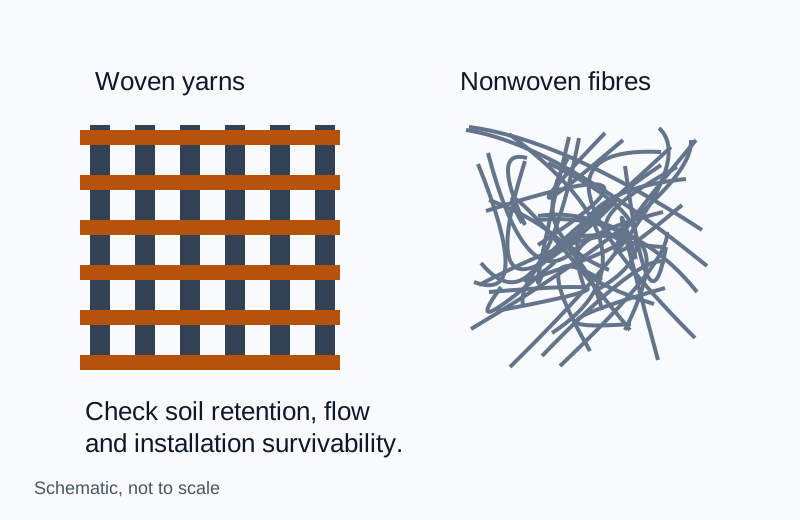
Needlepunched nonwoven fabrics are common drainage filters. Woven geotextiles include different yarn constructions and can serve filtration, separation or reinforcement applications when their tested properties match the design. The important distinction is the required function and the actual product data.
What woven and nonwoven construction changes
| Selection question | Woven fabric | Needlepunched nonwoven fabric |
|---|---|---|
| Structure | Interlaced yarns | Mechanically entangled fibres |
| What to inspect | Yarn form, opening distribution, hydraulic properties | Opening size, permittivity, strength and thickness |
| Typical specification issue | A separation or reinforcement product may have unsuitable filtration properties | Weight alone says little about soil retention or long-term clogging |
| Approval basis | Tested properties and soil compatibility | Tested properties and soil compatibility |
For a French drain, start with the soil gradation and groundwater conditions, then check the designer’s retention and permeability criteria. Fine or difficult soils may need specific filtration testing. “High flow” is useful only when the filter also retains the soil and maintains the required flow over its service conditions.
Read a real datasheet: Mirafi 140N
The archived Mirafi 140N manufacturer datasheet, hosted by Pacific Pipeline, describes a polypropylene needlepunched nonwoven. This is a representative product specification, with an AASHTO M288-06 Class 3 statement in that document.
| Property | Test method | Value in the archived sheet |
|---|---|---|
| Grab tensile strength, MD and CD | ASTM D4632 | 120 lbf (534 N), minimum average roll value |
| Apparent opening size | ASTM D4751 | No. 70 sieve (0.212 mm), maximum opening diameter value |
| Permittivity | ASTM D4491 | 1.7 s⁻¹, minimum average roll value |
| Flow rate | ASTM D4491 | 135 gal/min/ft² (5,500 L/min/m²), minimum average roll value |
The different units matter: permittivity is expressed in reciprocal seconds; flow rate is expressed per area under the test conditions. Neither is the discharge capacity of the completed trench. Obtain the current product submittal and compare it with the project’s required standard edition. Solmax’s M288-24 technical note is a separate, newer reference; an older product sheet’s compliance statement should remain tied to its stated edition.
Build a continuous filter boundary
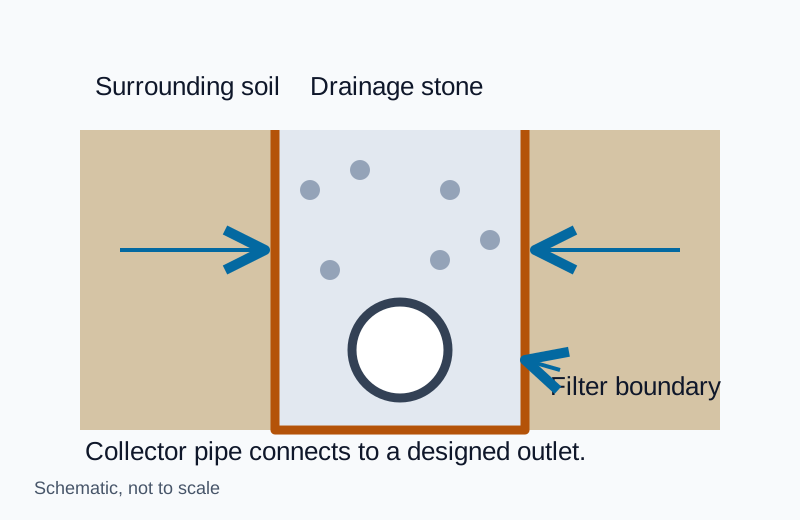
Inspect the prepared trench before fabric placement. Remove sharp debris and repair unsuitable surfaces according to the work specification. Avoid dragging rolls through mud or exposing them to vehicle traffic beyond the approved installation method.
Maintain the specified overlaps, seams and end closures. A gap can allow soil into the aggregate even if the fabric itself has excellent test results. Required overlap depends on the product, ground conditions and loading; include the actual project detail in the installer briefing.
Use the specified drainage aggregate and protect the fabric during placement. Close and cover the system in the planned sequence to prevent construction sediment entering the drainage zone. Record concealed seams, pipe transitions and outlet connections before backfill.
Diagnose slow drainage as a system problem
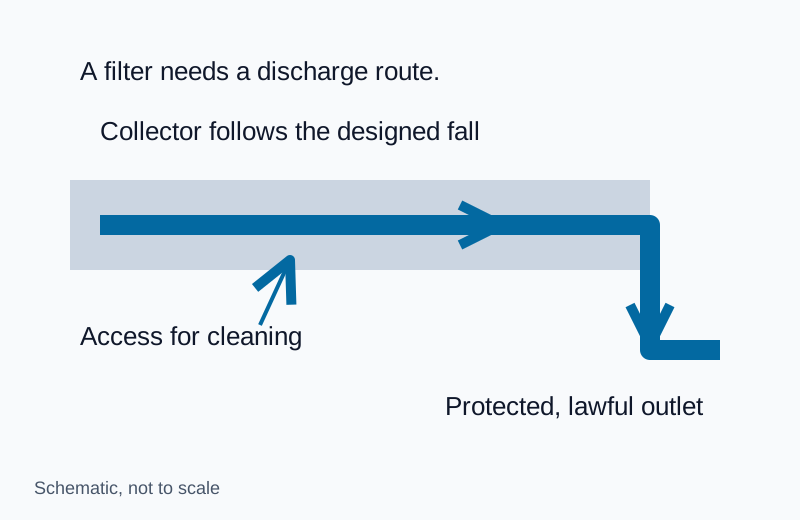
Check the outlet first, then pipe grade, blockage, aggregate contamination and filter compatibility. Water ponding beside a drain can result from a missing discharge route or a blocked pipe, not only from the textile. Replacing the fabric without examining those interfaces may leave the original problem intact.
Submittal and inspection checklist
Request the exact product designation, current datasheet, roll identification, specified test methods, soil filtration basis and installation instructions. Confirm how damaged fabric will be repaired and who accepts the work before it is concealed. Keep observations tied to location and photographs.
Fabric weight labels such as 4 oz, 6 oz or 8 oz are purchasing descriptors, not a substitute for these checks. Higher mass does not by itself establish better filtration for a particular soil. Likewise, reinforcement strength cannot be assumed from the appearance of a woven roll.
Drainage excavation requires its own utility-location, access and protective-system plan. Follow the applicable excavation requirements and competent-person inspections; the geotextile selection does not determine a safe excavation slope.
For walls, continue to weep holes and hydrostatic relief. The sitework hub connects drainage design with compaction and earthwork control.
Explore the related topic and technical references.