Proctor compaction test: standard vs. modified and optimum moisture
Compare ASTM D698 and D1557, interpret maximum dry density and optimum moisture, and connect laboratory results to lift control and field density testing.
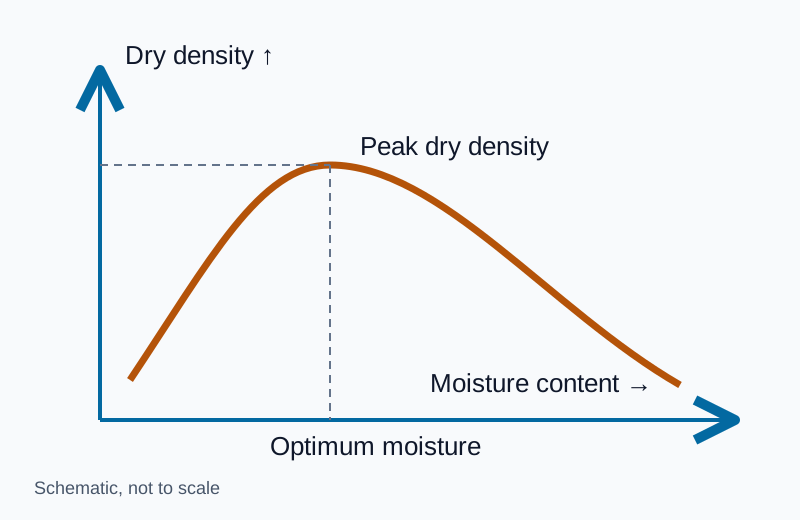
The Proctor test establishes the relationship between a soil’s moisture content and its dry density under a specified laboratory compaction effort. The peak identifies maximum dry density (MDD) and the corresponding optimum moisture content (OMC). Field acceptance compares the in-place dry density with the specified laboratory reference for the same material.
A requirement for 95% compaction means 95% of that reference MDD. It is not 95% solids by volume, and “95% Proctor” is incomplete unless the test method and material are identified. The project’s geotechnical specification sets the required percentage, moisture range and test frequency.
Standard and modified Proctor compared
| Question | Standard Proctor | Modified Proctor |
|---|---|---|
| ASTM method | D698 | D1557 |
| Laboratory compaction effort | 12,400 ft-lbf/ft³ | 56,000 ft-lbf/ft³ |
| Relationship measured | Moisture versus dry density | Moisture versus dry density at higher effort |
| Typical change for the same soil | Reference curve | Usually higher MDD and lower OMC |
| Acceptance use | When specified by the project | When specified by the project |
The standard-effort value comes from ASTM D698, section 1.1, in this publicly archived edition. The modified effort and comparison are documented in the Nebraska DOT study, Proctor Compaction Testing, including its table comparing the two methods. Use the contract’s required edition, method and oversize-particle treatment when ordering testing.
Modified Proctor is a different laboratory reference, not a universal upgrade to a field acceptance specification. Changing the denominator changes the reported percentage. A conversion developed for a particular soil population should not replace a test on the material being placed.
Read the laboratory report before testing the fill
Check the material description and sample source, the ASTM method, the date, the compaction curve, MDD and OMC. D698 includes different methods selected according to gradation and limits its applicability to specified particle-size distributions. Coarse or free-draining materials can require a different acceptance approach established by the geotechnical designer.
A change of borrow source, noticeable gradation change or blended material should trigger review of the reference curve. Otherwise a perfectly recorded field measurement may be compared with the wrong soil. Keep the reference report identifier on each field test record.
Convert wet density to dry density correctly
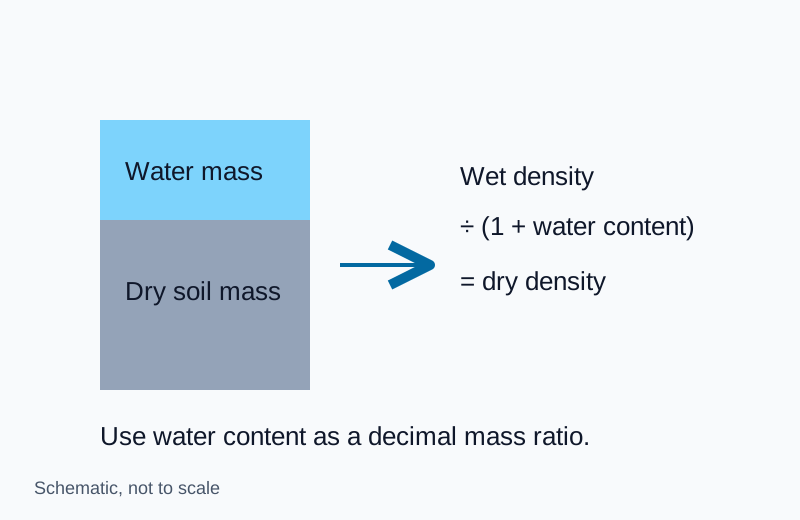
Field instruments may report wet density and moisture information. Relative compaction uses dry density. Use consistent density units and moisture expressed as water mass divided by dry soil mass:
Dry density = wet density ÷ (1 + moisture content as a decimal).
Relative compaction (%) = field dry density ÷ reference MDD × 100.
Check whether the instrument already supplies dry density before applying any conversion. Applying the moisture correction twice understates the result.
Control the lift before measuring it
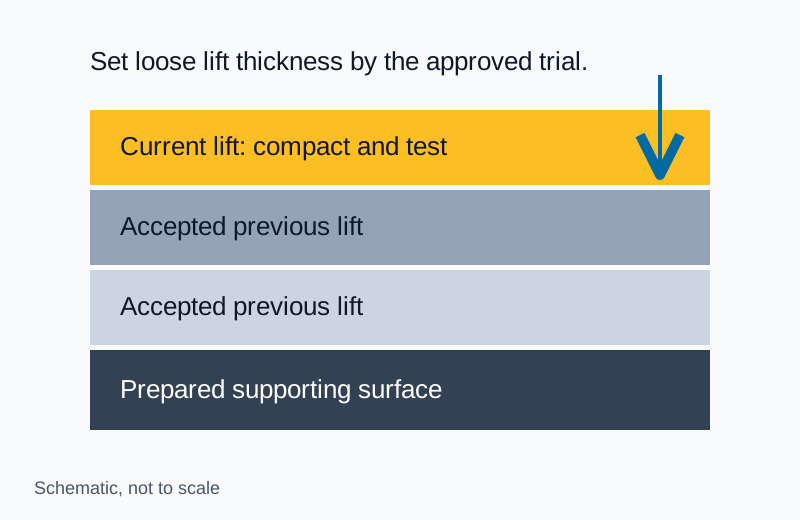
Select loose lift thickness, moisture conditioning and roller passes through the approved method and field trial. Equipment, soil type, access and the supporting layer affect the workable combination. A thick layer can pass a shallow measurement while retaining an inadequately compacted zone below.
Record the lift location and elevation, material source, loose thickness, conditioning, equipment and passes. Place subsequent lifts only after the required acceptance. Where pumping, rutting or unstable support is observed, involve the responsible geotechnical professional rather than simply adding passes.
Nuclear density gauge checks and failed results
A nuclear gauge requires trained, authorized operators and the applicable radiation licence, transport and site controls. The approved testing method governs calibration or standard checks, surface preparation, measurement mode, probe depth and moisture corrections. Keep the actual instrument record with the test location, reference Proctor and acceptance decision.
For a failing result, first verify the material reference, units, moisture and measurement setup. Then follow the approved corrective action: moisture adjustment, reworking the lift, reducing lift thickness or investigating unstable support. Retest the corrected area with traceable records; do not average away isolated failures unless the specification expressly defines that acceptance approach.
Coordinate testing access with the excavation plan. U.S. excavation protection and competent-person duties are addressed in OSHA 1926.651 and 1926.652. A density result establishes neither trench stability nor safe entry.
Continue with drainage geotextile selection or return to sitework and drainage.
Explore the related topic and technical references.